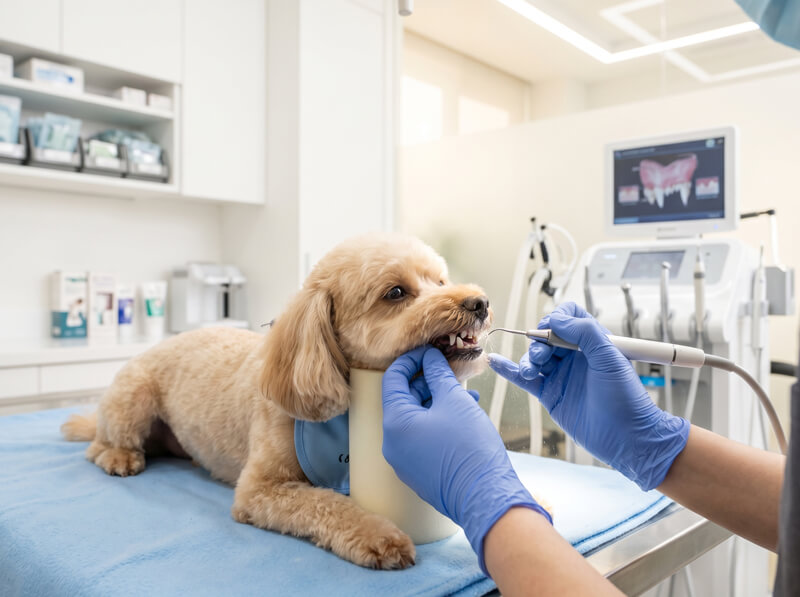
Complete Dental Care for Your Pet
At Angel City Animal Hospital, we provide both routine and advanced dental care to keep your pet's mouth healthy and prevent painful infections. Professional dentistry is key to preventing long-term complications in vital organs like the heart, liver, and kidneys, which can be affected by oral bacteria.
Whether your pet needs a preventive cleaning to remove plaque and tartar or specialized surgical extractions and periodontal therapy, our experienced team uses state-of-the-art diagnostic tools and precise, fully monitored anesthesia to ensure safe and effective care.
Our Dental Services
We offer comprehensive dental procedures designed to treat everything from routine tartar buildup to advanced periodontal diseases:
💤 Safe General Anesthesia
Continuous vitals monitoring (oxygen, heart rate, blood pressure, temperature) by a dedicated veterinary nurse for all procedures.
✨ Ultrasonic Scaling & Polishing
Using advanced ultrasonic tools to remove tartar and plaque, followed by polishing to deter future buildup.
🦷 Digital Dental X-Rays
High-resolution imaging to evaluate tooth roots, detect painful bone abscesses, and identify hidden bone loss.
🏥 Surgical Extractions
Safe, veterinary-monitored extraction of fractured, infected, or severely diseased teeth with local nerve blocks to minimize pain.
🐾 Periodontal Therapy
Subgingival scaling, root planing, and local antimicrobial applications to reduce deep pocketing and preserve salvageable teeth.
🦷 Comprehensive Oral Exam
Inspecting and probing every tooth, charting any pockets, recession, or structural damage for tailored future care.
Frequently Asked Questions
Find answers to common questions about pet dental cleanings, advanced care, and home oral health.
Why does my pet need anesthesia for dental cleaning?
Anesthesia is essential because it allows us to perform scaling below the gumline where the most serious periodontal disease occurs. It keeps your pet completely still, eliminates pain and anxiety, and allows us to insert an endotracheal tube to protect their lungs from water and bacteria during the cleaning.
How can I tell if my pet has dental disease?
Common signs of dental disease include persistent bad breath, yellow or brown buildup (tartar) on the teeth, bleeding or red gums, drooling, reluctance to eat dry food or chew toys, pawing at the mouth, and loose or missing teeth.
What is the difference between routine dentistry and advanced dentistry?
Routine dentistry focuses on preventive care, including oral examinations, scaling plaque and tartar, polishing, and applying fluoride or sealants. Advanced dentistry is required when dental disease is already present and includes treatments such as tooth extractions, oral surgery, root canals, and treating severe periodontal infections.
Ready to Book a Dental Consultation?
Prevent pain and maintain your pet's bright smile. Contact us to schedule a dental consultation or to book your pet's cleaning.